

Megan Jones and Rosie Beetschen share two perspectives on volunteering and restoration in Abernethy Forest
Rosie: I’m perched in the open boot of my car, pulling on wellies. There’s still ice on the ground here at the Loch Garten Nature Centre. Booted and layered up, I take a moment to breathe in the forest. The wind is sharp and fresh, so the trees toss their branches with a lot of huff and drama.
Beside me, my rucksack holds a spare fleece, my camera, a packed lunch and a thermos of tea. On the other the of the car park I can see Megan and Ewan, our leaders for the day, chatting with the arrivals.
Megan: It’s lovely to see a few keen volunteers are already here. A slow trickle of people arrive, exchanging smiles and names, and we gather in a corner where the lingering ice has melted. I am warmed by thefriendly and diverse group of local people that are here to support our bog restoration efforts.
With bogs often receiving less attention, engagement, and love than other habitats, I’m excited to share the beauty and importance of our peatlands. Today we’re working in bog woodland habitat, a rare and beautiful part of the forest mosaic.
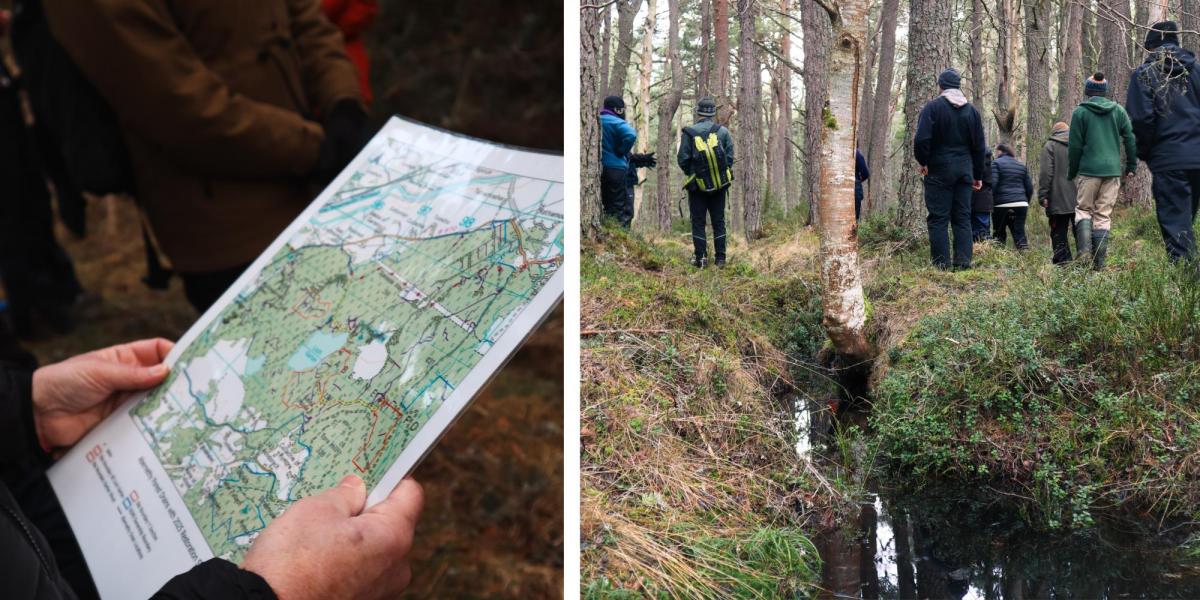
Rosie: There’s a buzz of excitement as we crunch down the path to a waiting truck loaded with logs; we’ll have to carry them a short distance over to the dam-building site. They’re heavier than they look. I heave one up and onto my shoulder and it’s clammy to the touch, crackled with bark and mud, leaving crumbs on my jacket. It smells of damp and sweet loam.
We form a train through the forest, carrying the logs. An overwhelming sense of competitiveness takes hold of me and, on my second run, I stagger through the trees with one on each shoulder, heart pounding with the exertion. Wood thrown down in relief, we gather round Megan and Ewan. Before we get started, they want us to understand why it’s so important that this work needs to be done.
Megan: Bogs are deeply connected to human history. Commercial felling began here in the early 17th century and proceeded in waves into the 20th century when major timber extraction occurred to support the wars. The forest extent fluctuated during this period and peat was cut locally with some drains being connected to peat-cutting sites. Comprehensive drain networks were dug up until the 1980’s, increasing water flow out of bogs and wet wood areas to make the land dryer and more favourable for forestry.
It feels hard to imagine the efforts made to drain this land. Wet places are both a blessing and a curse; they have the resilience for survive for millennia, but humans have often wanted to make them dryer, and more ‘useful’. We are becoming part of the land’s history today, reversing the harmful effects of drainage that leaves the forest less biodiverse and ecologically resilient and more vulnerable to forest fires.
Rosie: To the untrained eye, this patch of forest would seem like any other. It’s hard to see how precious it really is, until you really appreciate the impact history and humans have had.
“Do just take a moment to appreciate the wood”, says Ewan, looking up at the rustling canopy above us. “We’re in one of the original parts of the old forest. Some of these trees are 300 years old”. For a moment, we pause. Around us are pine, juniper, rowan; we’ve passed birches and willows. And dotted between are these dark, wet, bog pools - reflecting the branches of bare trees on their still surface.
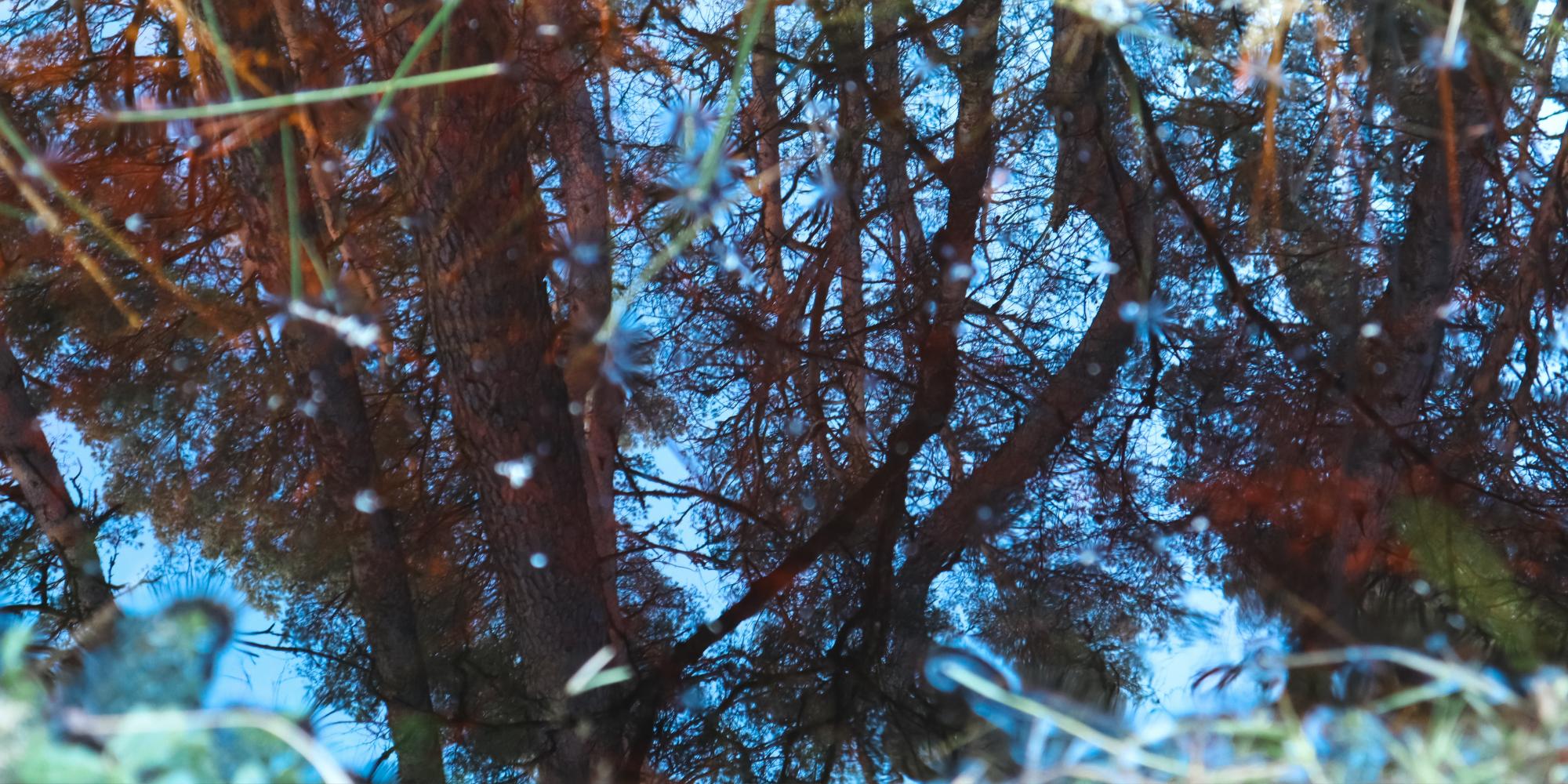 Image: the reflection of the Abernethy trees in a boggy pool
Megan: After some demonstrations, the group begin with tasks they are naturally drawn to. A few begin in the drain, digging out notches and channels to accommodate the horizontal logs. Others disperse into the forest to gather turfs of vegetation and soil that will be used to infill the dam. The gentle chatter of voices and tools resonates softly through the vegetation.
Soon enough we start to position our upright stakes that will support the dam. We use a mell to knock posts into the ground and I encourage different group members to take turns at this invigorating task. Volunteering days bring people with a variety of skills and knowledge, and it is lovely to support people in trying new things.
When you get the right angle and good contact with the wood you hear a very satisfying clap – clap - clap! These sounds must stir the forest’s memory of people at work here.
Rosie: The dam will need to be packed with turf, so a few of us fan out into the forest with spades. The terrain is unreliable: hillocks, clumps of heather, tangling blaeberries. The spade in my hand scratches metallically against branch and leaf. The knock of the mell ricochets off the trees, steadily quietening with distance. I choose a clear spot to dig, spade slicing through soil. My arms ache. I pick up the fresh-cut square of turf and cradle it to my chest to balance its weight. It smells of growth and decay, damp and spring.
Back at the drain, the other half of my group have lined up posts on either side. It’s remarkable how wet the ground has already become. The base logs sigh and huff wetly as they’re coaxed into the mud. We gaze at our handiwork, proudly.
Megan: We take a welcome lunch break under the trees and have an opportunity to talk more about the different wildlife that could benefit from our efforts. Ewan shares a few of the beautiful dragonfly and damselfly species, including the white-faced darter, northern emerald and northern damselfly, that could find a home here.
Acidic bog pools with an abundance of sphagnum provide breeding opportunities and woodland makes for roosting and feeding. The hum of iridescent dragonfly wings cruising over these bogs is a summertime delight.
Rosie: I have to unclench my boot from the suck of mud to get out of the drain, and can’t help but lament the struggle – in a short time, the bottom of the ditch has already started to become waterlogged.
‘What are you talking about?’ cries Ewan. ‘It’s perfect, boggy mud, it’s just what we want!’.
It’s a sticky reminder that what might not be comfortable for me might be beautiful for the habitat.
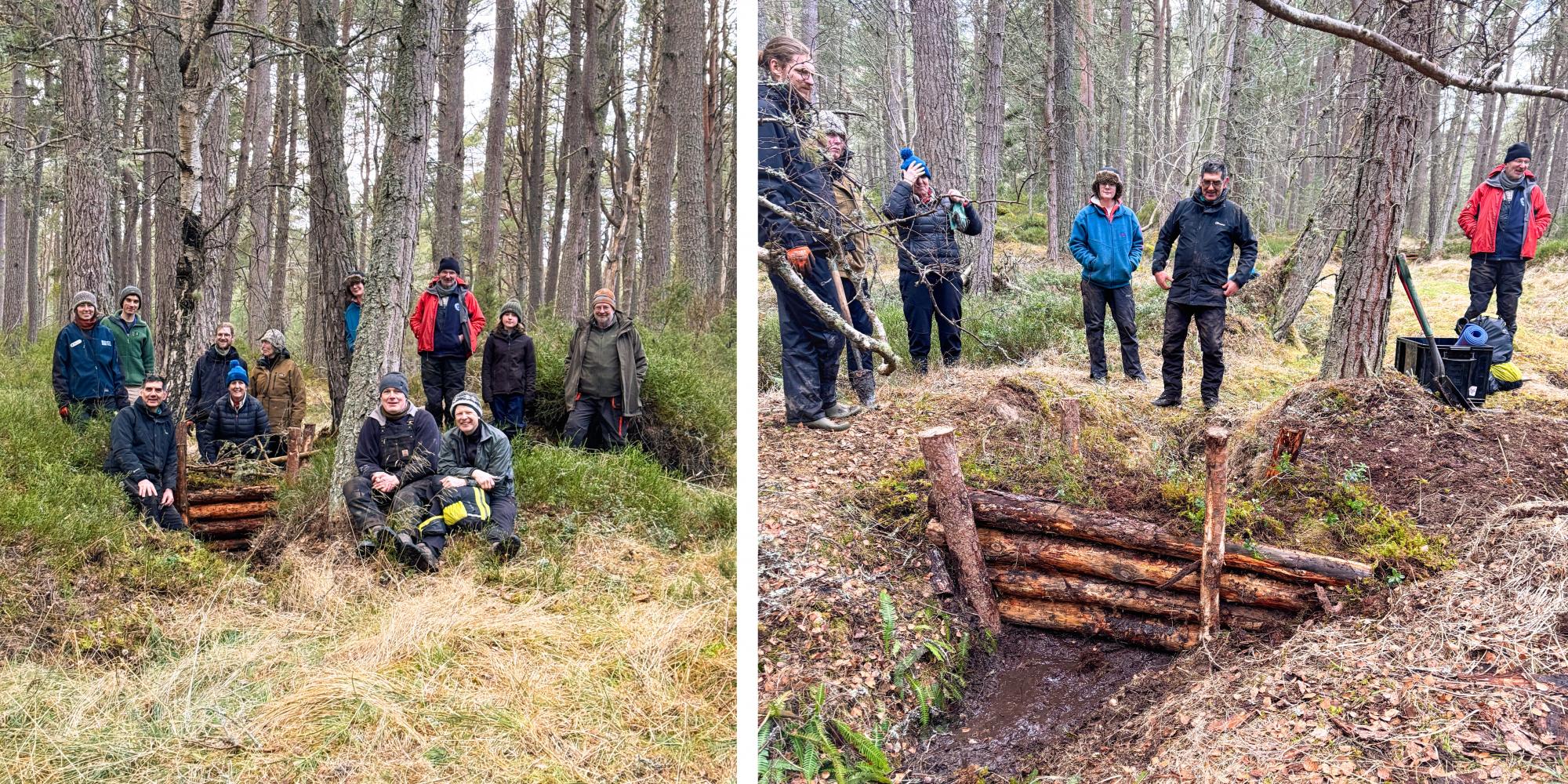 Images: the team of volunteers gather around their finished dam (right); another finished dam, showing the structure and process that has taken place (left)
Megan: After finishing building our dams, we walk over to another part of the nearby forest that is more typical bog woodland habitat. The landscape opens up with fewer more stunted pines spaced out amongst the bog vegetation. These pines have a yellow tinge to their needles due to the waterlogged soils holding less nutrients which also impedes their growth.
At their feet, a rich assemblage of sphagnums, ericaceous shrubs, and lichens are a feast for the eyes. Whilst it will take a long time for areas of the forest that were drained to evolve into bog woodland habitat, it feels important to connect these different parts of the forest for people and highlight the beauty of the bog woodlands we are grateful to still have here.
Rosie: We’ve carried logs and hammered them in, cut and carried turf to stamp down. We’ve shared tired bones and mud-stained jackets, shared a deeply-packed sense of pride in the work we’ve achieved. And, at the end of the day, we share a group photo with a finished dam, before separating, no longer strangers, and heading back to our cars.
Megan: Quietness fills the woods again, with only the flutters of birdsong and gusts of wind until our next volunteer day.
Looking to join a volunteer day? Sign up to our newsletter for updates and opportunities here
The peatland work at RSPB Scotland's Abernethy National Nature Reserve is funded by Peatland Action administered by the Cairngorms National Park Peatland ACTION team.
RSPB Abernethy are grateful to Net Zero Scotland's Nature Restoration Fund, managed by NatureScot, for supporting their work
We head to RSPB Scotland Insh Marshes in the south of the Cairngorms Connect Partnership to hunt for a very rare Hoverfly
Ellie Dimambro-Denson, Monitoring Officer for Cairngorms Connect, writes about the initial success of high-altitude woodland restoration in our montane landscape.


