

What does it mean to be called 'old woman' in nature? Cairngorms Connect Communications Officer, Rosie Beetschen, finds out.
Cailleach is Gaelic for old woman, although it often means hag. It is the name given to the Scottish Queen of Winter in mythology, who roils the winter sea and freezes the land solid, but wider references to old women are scattered across the landscape and languages of Scotland.
Standing over 930 metres above Newtonmore is the munro A’Chailleach, The Old Woman. Craggy-topped, she’s one of the highest in the Monadhliath.
Birds are named Cailleach: Cailleach-oidhche is the Gaelic name for an owl. Translated to English, it means ‘night hag’. Cailcheag-chean-dubh means ‘little old lady with a black head’, the name for a Coal Tit.
There’s a wizened Cailleach standing over Lochan Uaine in Glenmore. She has twisted arms, a gnarled body. She has been there for hundreds of years. But she doesn’t go by the name Cailleach; trees like her are known as Granny Pines.
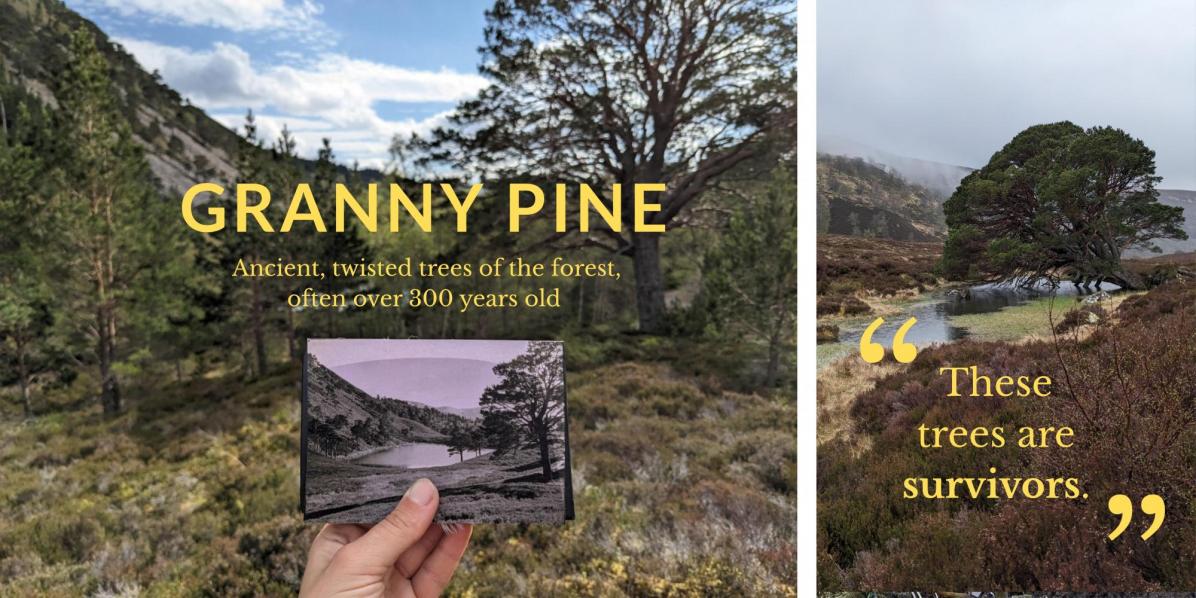
I spoke to Ellie Dimambro-Denson, Cairngorms Connect’s Monitoring Officer, who spends many days of the year surveying the trees in the partnership area, about the Granny Pine.
“Granny Pines are the old, open, twisting trees of the forest”, says Ellie. “Generally, they’re over 200 years old - although some have been dated to more than 500 years old.”
Wolves might have walked under these trees; Granny Pines have stood sentinel as the landscape around them has changed, watching silently as trees have grown, been felled, and grown again.
“They’ve lived a lifetime spanning the same vision we have for Cairngorms Connect”, says Ellie.
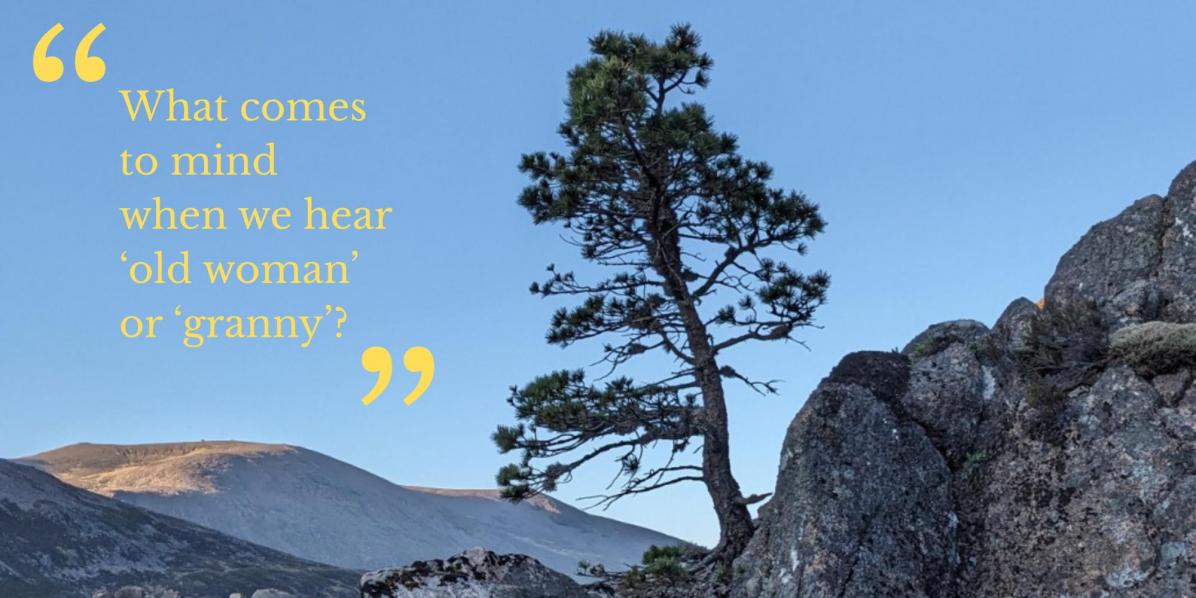
What comes to mind when we hear ‘old woman’ or ‘granny?’ You might associate the word with frailty, someone that needs to be looked after and supported in great age. But it’s quite the opposite with the Granny Pine.
These trees are survivors. Hundreds of years ago, they escaped the axe, perhaps because they were too twisted already to be used for logging, perhaps because they were slightly harder to access.
With age comes strength and wisdom, and these trees became the beating heart of the natural community.
“They give rise to an abundance of species”, continues Ellie, “invertebrates, lichens and fungi - a diversity that increases with age.”
Cailleach’s translation to ‘hag’ may describe an old woman as ugly, gnarled and crooked – but this growth makes the Granny Pine more hospitable for other species. Their large, twisting branches are generally those favoured by Capercaillie as an overnight perch within the forest.
Standing under a Granny Pine is a humbling experience. It has a vast canopy of knotting, forked branches, which can host rowans, ferns or blaeberry. It can almost blot out the sky above.
But look a little closer and you’ll see that the tree gives life to so much more.
Holes are formed when limbs break off at the trunk and rainwater is let in, creating rot holes, inside which tiny Crested Tits build their nests.
And if these rot holes fill with rainwater, female Pine Hoverflies lay their eggs here, and with the larvae living within the watery hollow, filtering food from the bacterial soup of rainwater and Scots Pine sawdust. When the adult flies emerge in the early summer, they feed on the flowers that surround the Granny Pine.
In this way, the Granny Pine gives life to a fly which then gives life itself through pollination.
Somewhere in Abernethy Forest, records say there is a huge Granny Pine known as ‘the Queen of the Forest’. Her whereabouts are unknown, if she still stands at all.
If she has fallen, she takes on new life and new powers, in the form of deadwood, which supports an even greater diversity of species including the critically endangered Blood-red Longhorn Beetle.
From ‘Cailleach’, a wizened, twisted hag, to ‘Granny’, centre of the community, queen of the forest, these Pine trees redefine what it means to grow older.
With age comes strength, wisdom, and the passing down of new life and growth. Cairngorms Connect has a 200-year vision for landscape regeneration – what incredible change might come about in that kind of time-span?
For these trees and all things growing with and around them, Cailleach and Granny are words of accolade. Aging is a gift to be treasured - and passed on.
For more pieces like this, subscribe to our newsletter here.
Thanks to Rare Invertebrates in the Cairngorms (RIC) and Cairngorms Connect partner Forestry and Land Scotland for supplying knowledge and support.
We talk to staff and volunteers working on restoring and researching the buried graveyard at Invertromie.


