We join a Twinflower survey to see the vital work being carried out to help this beautiful and rare flower
It’s the first day where it feels like spring has arrived. I am tramping through Abernethy Forest with Twinflower expert, Andy Scobie, as the warm sun slants through the pines.
“I love being out here,” Andy says, as he walks. “On days like this, especially, but even the windy and rainy days too. I like the solitude of it”.
I walk in his footsteps through shin-high heather; we snake deeper into the forest.
We’re heading to survey a patch of Twinflower. The plant has become incredibly rare and a focus of restoration by Cairngorms Connect partners, through monitoring of existing patches, translocation of the plant, and the creation of a Twinflower nursery.
A clonal flower, its patches often consist of only one plant. Because they are currently spaced so far apart, insects can’t travel between them and cross-pollinate. As a result, most patches produce very little seed, leaving the plant unable to disperse and colonise new areas of suitable habitat.
There are 60 Twinflower patches on the Abernethy reserve, but only 400 in the whole of Scotland.
We come into a dappled spot of the forest, punctuated by tall pines. The sun squints through the trees and lights up patches of moss a vivid green.
“You tell me when you spot the Twinflower”, says Andy, and I turn my eyes more firmly to the ground.
It’s a tangle of Blaeberry and Heather, moss and grass. To make things even harder, it’s too early for the Twinflower to be in bloom, so I’m not guided by the carpet of pink-white bells I have seen in the past.
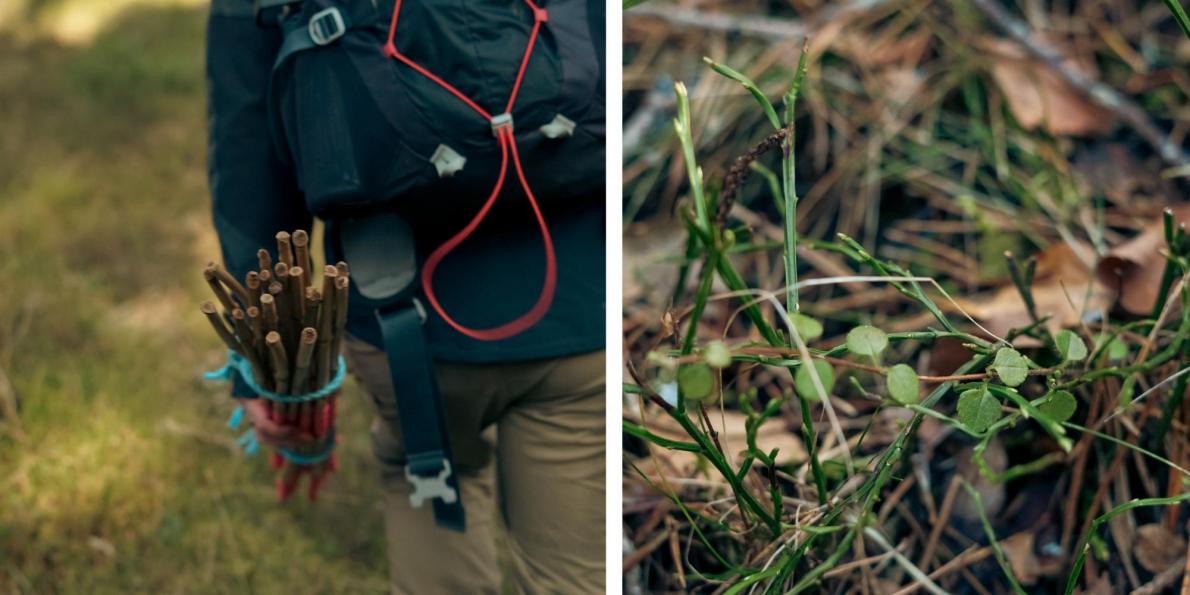
I know I’m looking for delicate long stems with paired circular green leaves running along, but I can’t see anything yet. An evergreen, its leaves are at least visible all year round – although perhaps not yet to me.
Andy walks ahead of me, marking each sighting with a post, to form a perimeter around the patch, mapping a polygon onto his phone with the data.
“We didn’t have these survey apps in the past”, he remarks.
Andy first surveyed this plot 15 years ago. He’s been asked to return by the RSPB and will be comparing against the baseline data he gathered all those years ago.
“You used to have to carry a notebook, a pen and a camera. You’d have to scribble down stuff in the rain, so the GPS does make my life an awful lot easier.”
I hunker down by the marker; I still can’t see the Twinflower, and Andy can spot it from walking. It evidently takes a sharp eye that knows what it’s looking for – technology can only help so much.
But then, all of a sudden, it feels as if my eyes come into focus. The leaves are a more vivid green than their surroundings; they knot and tangle in patches stretching out from where I stand.
The area they cover, now marked out by Andy, is surprisingly vast. Without knowing what to look for, I never would have spotted it when it isn’t flowering.
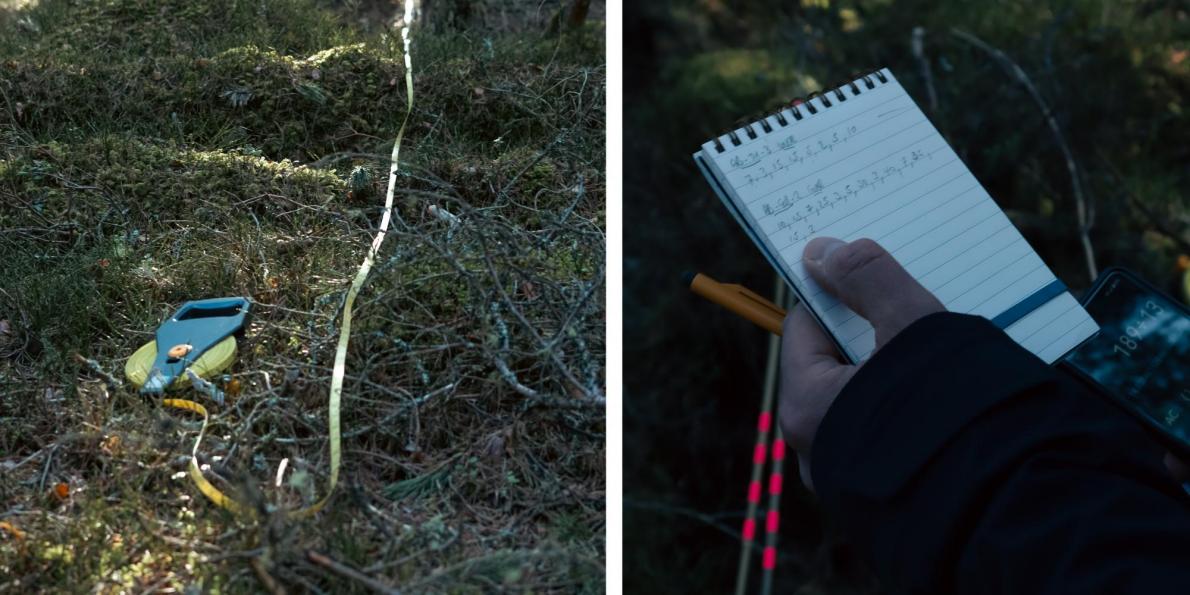
Andy runs a yellow tape measure across the length and breadth of the patch.
“I’ve had this tape measure since 2010. I was in my mid-20s when I first surveyed, just out of my PhD. I wonder how many Twinflower patches this tape has measured.”
It’s time to measure the density of the plant. The main constraint for Twinflower is being out-competed by tall Heather and Blaeberry, and by a deep moss layer. Grazing, browsing and disturbance by cattle or small numbers of deer can help to cut down the vegetation and keep the field layer open.
Another limiting factor is how much light can get through to the flowers. We stare up at the forest canopy, to get a measure of its density.
The wind is gently rocking the pines, the sky a chalky blue behind.
I reluctantly return my gaze back to the forest floor, and see Andy taking photos of the site, musing as he does so.
“I wonder who’ll look at these photos next? Maybe it’ll be me, in another 15 years’ time! What a thought that would be.”
I ask him how things have changed in the last 15 years.
“I set up Twinflower translocations in 2014 and that was pioneering work back then. Since then, staff across the Cairngorms Connect landscape have been monitoring them and Cairngorms Connect have gone on to set up more sites. Beyond here, landowners across Scotland have been setting up translocation sites, too.”
“There are so many more people involved in Twinflower Conservation now than there were. The momentum is really building.”
We’ve spent the morning reflecting on the past 15 years. In light of Cairngorms Connect’s 200-year vision, what does Andy hope for the future?
“At the moment, we have a persisting group of clones but no new individuals. We’re hoping to restore a genetically diverse seeding population that will spread around to create new individuals -perhaps those adapted to the current climate.
“It’s all about resilience, equipping the population to adapt to change, to the future.”
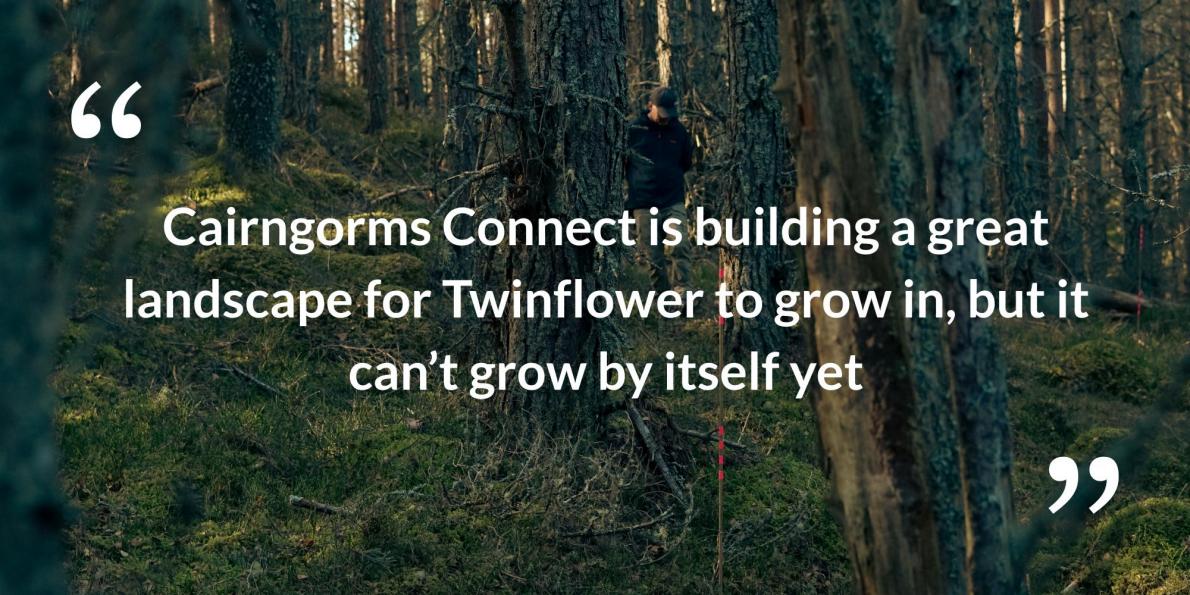
Cairngorms Connect is building a great landscape for Twinflower to grow in, but it can’t do it by itself yet.”
It takes a keen eye and a lot of patience, but Andy brings something equally important: hope of a verdant future for this precious flower.
We talk to staff and volunteers working on restoring and researching the buried graveyard at Invertromie.