

Ellie Dimambro-Denson, Cairngorms Connect Monitoring Officer, looks back on ten years of protecting and restoring the rare and delicate Twinflower
It's summer amongst the Abernethy Pines, the sun warming the pine needles and casting a deep warm honeyed scent onto the breeze as I walk, keeping my eyes towards the field layer in anticipation, knowing I’m nearby. I take a few more steps and then I spot pairs of familiar rounded, slightly notched leaves and then some more, connected by long slender stems – stolons – and then an entangled mat and I look up to see a delicate sea of pale pink spreading between the Mosses, Grasses and Heather amongst the trees. A patch of Twinflower. I mark the outer edges with bamboo canes and tape measures and duck down with a quadrat to start recording.
It's August 2024 and I’ve come out to survey one of the few remnant Twinflower patches at RSPB Abernethy. Twinflower was once widespread across the ancient Caledonian forests of the Scottish Highlands, but centuries of deforestation and the conversion of natural forests to managed plantations have greatly diminished its distribution within Scotland to small, isolated patches like this one. This once-common species is now classed as nationally scarce.
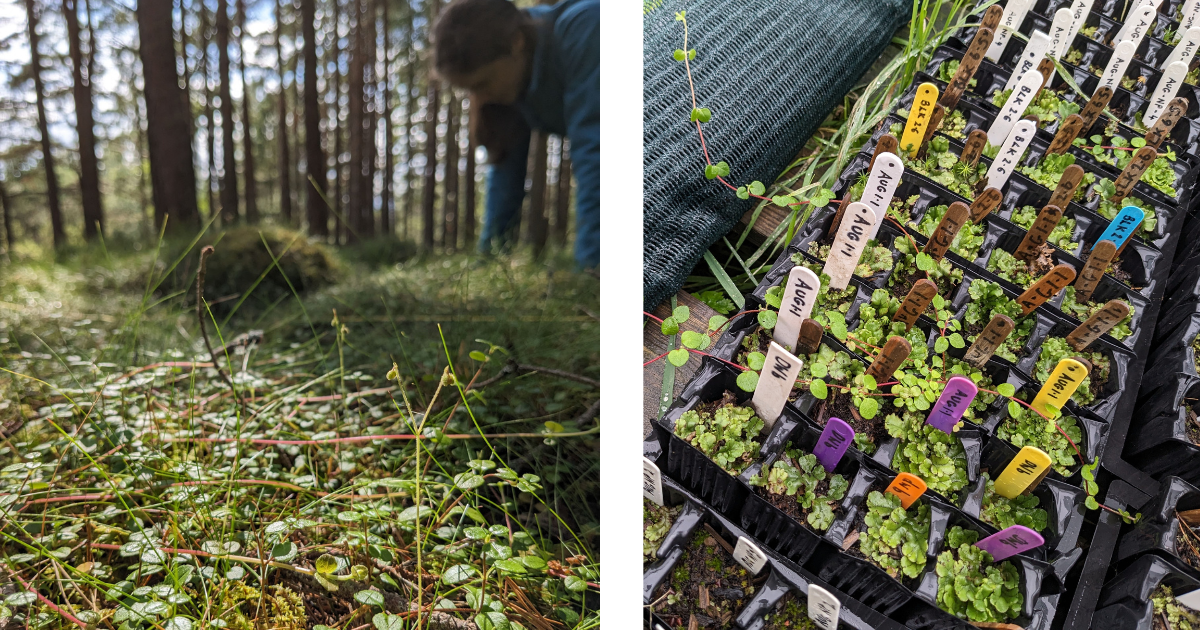 Image: (left) Ellie crouches down by a patch of Twinflower (right) Twinflower being grown at the Cairngorms Connect Tree Nursery
Although this patch covers several hundred square meters, this spreading expanse is actually just a single genetic individual (or ‘clone’). And herein lies the problem: not only are Twinflower patches few and far between, most of the remnant patches in Britain are made up of just one clone. These patches may reach great size through vegetative spread, but are unable to cross-pollinate with other individuals, as patches are too far from each other for pollinating insects to travel between. And without cross-pollination, seeds can’t be produced to help new generations of Twinflower establish and spread, with the severe lack of genetic variation making each remaining patch vulnerable to localised extinction from factors like fire, forestry work, disease or environmental change.
To help protect Twinflower from extinction in Britain, in 2014, a series of translocations were set up as part of the Cairngorms Rare Plant Project, led by Andy Scobie, to bring multiple isolated clones together. A total of 72 unique-clone plots were planted across 12 sites. Six of these sites were located at an existing natural patch, planting a range of clones around the natural patch to help enable cross-pollination over time. The other six sites were located in new areas of suitable habitat, planting six clones into each site to enable a genetically diverse population to develop over time. I’m at one of the natural patch sites today to measure both the health of the original natural patch, and to measure the growth of the eight new unique-clone plots that have been planted around it.
.png) Image: a diagram showing Twinflower planting around a natural patch
Image: a diagram showing Twinflower planting around a natural patch
I last monitored this site five years ago, and arriving back on back on site in 10 years post-translocation, I’m astonished by how much some of the plots have spread in that time. At the time of planting, each plot covered a maximum of 4m2; ten years on, Twinflower had spread to almost five times that, with the average plot covering more than 19m2 and one plot even reaching a whopping 42m2. All but four of the 72 planted plots were alive and healthy ten years on, and across the 12 reintroduced sites, only one appeared to be struggling. At the other 11 sites, Twinflower were thriving, forming a dense mat of fresh green stolons across the plot.
There are signs of reproduction beginning to establish too: ten years after planting, more than half of the planted plots were flowering and around a quarter were producing seed.
It’s beginning: seeds are being produced again, their sticky surface awaiting a passing Deer or Badger to pick them up and pass them to a new part of the forest, helping to secure the future of Twinflower in the Cairngorms.
Following on from the promising success of the 2014 translocations, in 2020 we planted another 60 new Twinflower plots across ten sites in the Cairngorms Connect area. Five years on, our monitoring showed promising signs, with two thirds of the plots surviving and most beginning to spread. Unfortunately, the remaining third of the plots were not faring so well, and monitoring the habitat around the planted plots has enabled us to understand that the failures were probably due to these sites being too shaded by the dense tree cover at these sites. This new understanding will help us to better target new reintroductions to the most suitable habitat in future.
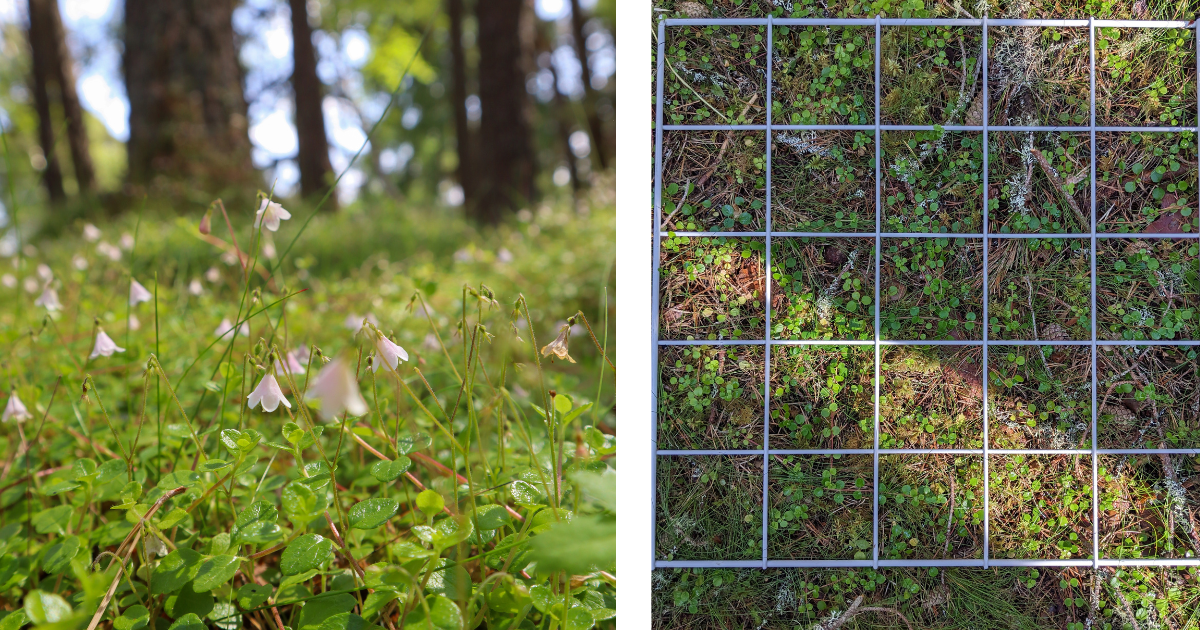 Image: (left) Twinflower in bloom in early summer (right) a quadrat laid on the forest floor
As I stand from my final quadrat, I look down to find a seed has caught hold of the end of my plait from my time surveying, nose down. I pull it free from my hair and place it in a collection tube to take back to the Abernethy Tree Nursery for planting. Along with another 239 seeds that we collected in 2024, these seeds will form the basis of genetic testing (currently ongoing), to help us understand whether the planted Twinflowers are already starting to cross-pollinate with other clones. If we can achieve this, we will be one step closer to securing the future of Twinflower in the Cairngorms once more.
Over recent months, the work to safeguard Twinflower’s future has expanded further. A Twinflower Nursery has now been set up at Abernethy, led by Plantlife and funded by the Scottish Government's Nature Restoration Fund, managed by NatureScot, safeguarding a small amount of material from many of the single-clone Twinflower patches across the northern Cairngorms to safeguard their future, as well as acting as a bank of material for future translocations. Perhaps, one day in the not-too-distant future, Twinflower will become almost ubiquitous amongst these trees again, the new planted islands giving way to seed, that seed spreading and falling to a recently scuffed piece of ground and growing in place, a new generation taking hold. And this – in one of the most nature-depleted countries in the world – will feel like another small victory.
We talk to staff and volunteers working on restoring and researching the buried graveyard at Invertromie.


