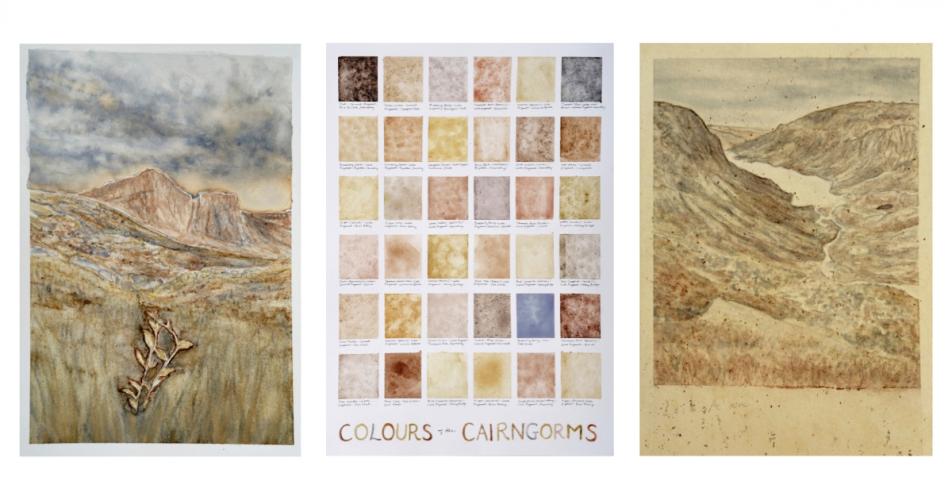
Ellie Dimambro-Denson, Monitoring Officer for Cairngorms Connect, writes about the initial success of high-altitude woodland restoration in our montane landscape.
Sat on the edge of a crag above Loch A’an as the final light of the day begins to fade in a rising chink of golden light, I turn to gaze across the open expanse below, through an entanglement of branches and soft leaves. I’ve scrambled up to perch beside one of the few remaining fragments of Downy Willow (Salix lapponum). Found in montane regions, these knee-high trees would once have formed a miniature woodland, but after centuries of human impact (especially browsing by deer and sheep), they’re now restricted here to a lofty refuge amongst granite walls, high above the loch sparkling below. Out of the reach of the hungry mouths of herbivores, but also far from others of their own kind.
Willows are diecious which means that individual trees are either male or female and need to be close enough to others of the opposite sex for cross-pollination by wind or insect to occur. Without cross-pollination, they can’t produce seed and these last few individuals, already precariously placed amidst the slip stream of rockfall and avalanches, are at risk of being lost. A survey in 2016-17 found that the seven remnant Downy Willow populations at Loch A’an were too small and fragmented to allow for enough cross-pollination to form a viable population, meaning they were ultimately doomed to extinction.
To combat this, forest restoration work has been underway by Cairngorms Connect and RSPB Scotland Abernethy Nature Reserve since 2021 to reconnect these fragmented trees. Over 14,000 Downy Willow plants – both seedlings and cuttings originating from other fragments within the Cairngorms – have so far been planted around Loch A’an and the adjoining area, alongside other montane tree species such as Whortle-leaved Willow (Salix myrsinites). They are grown by a community of volunteers at the Cairngorms Connect Tree Nursery on RSPB Abernethy and carried on a pilgrimage up and across the plateau by dozens of volunteers to their new home. They are planted both amidst the existing isolated trees so they might cross-pollinate and also spread throughout new areas, to reconnect the remnant individuals and start to rebuild this missing treescape.
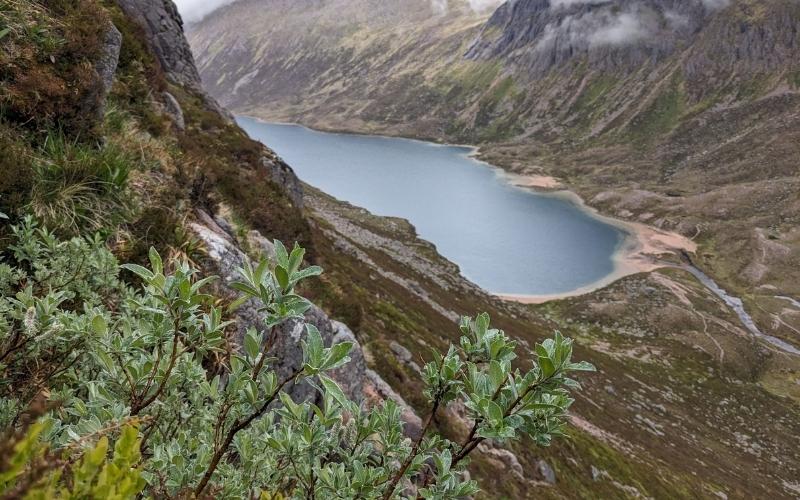
In the first year of planting Downy Willows at Loch A’an, we set up a series of monitoring plots to help us understand how they were surviving and growing in their new homes, as well as if they were producing catkins or being impacted by browsing
The same individual trees (125 of them) have been visited each year since. After four years in their new homes, the survival rates we’ve been seeing have been overwhelmingly positive with 99% of Downy Willows surviving, and the majority (85%) in a healthy condition.
For Whortle-leaved Willows – another montane willow with an even smaller cohort of trees left at Loch A’an – 98% of trees were surviving after two years at the site and 90% were in a healthy condition, from a sample of 48 trees.
Browsing was observed on about 40% of planted willows, which was predominantly by Mountain Hares over the winter months, but this browsing was often fairly minimal, impacting a small proportion of branches and not harming the trees’ overall survival. In fact, this minimal browsing may even benefit the trees by promoting a lower bushy growth, better suited to the wind-scraped gradients of the landscapes, as seen in places with established montane habitat such as South-West Norway. Encouragingly, there were relatively few signs of deer browsing, suggesting that ongoing deer management by RSPB Abernethy and Cairngorms Connect is protecting these trees from harm.
Alongside small mammals, we found plenty of signs of insects nibbling on their leaves too – another sign that these trees are already starting to feed and support the wider community. They’re starting to produce catkins, too. Although catkin numbers have varied year on year, 36% of the monitored willows have flowered at least once, creating a chance for cross-pollination to occur, seed to set and the possibility for Downy Willow to thrive as generations of new seedlings establish many years into the future.
Which brings me back to why I’ve climbed up to sit beside one of the lofty native Downy Willows, up on a rocky ledge at the end of a long field day. I’m here to collect ripe catkins from some of the original remnant females to bring back to the Cairngorms Connect Tree Nursery to grow on. We’re interested to find out if there’s already been genetic mixing between the original willows and the newly planted ones, sending seedling leaf samples to the Royal Botanic Gardens Edinburgh for testing.
As I pick catkins, some of the fluffy seed escapes and catches the light as it floats off on the breeze towards the open expanse before the loch below. Perhaps it will land on suitable ground and find a new home there? Then I spot what looks like a young seedling nearby, above the planted area. It’s already beginning. Trees are re-establishing where they have long been absent or hiding from view.
Looking across Loch A’an as the restoration begins to take form, a window opens into imagining a future to come. A mountain woodland returning.
You can more about our forest restoration work here.
Cairngorms Connect's Mountain Woodland Restoration work was made possible due to funding from the Endangered Landscapes and Seascapes Programme as well as Nature Restoration Fund and EU LIFE. Thanks to SSEN Distribution for funding continued work undertaken by the Cairngorms Connect Tree Nursery on RSPB Scotland Abernethy.
We talk to staff and volunteers working on restoring and researching the buried graveyard at Invertromie.